Think globally, be found locally
Berger+Team · Sep 22, 2026
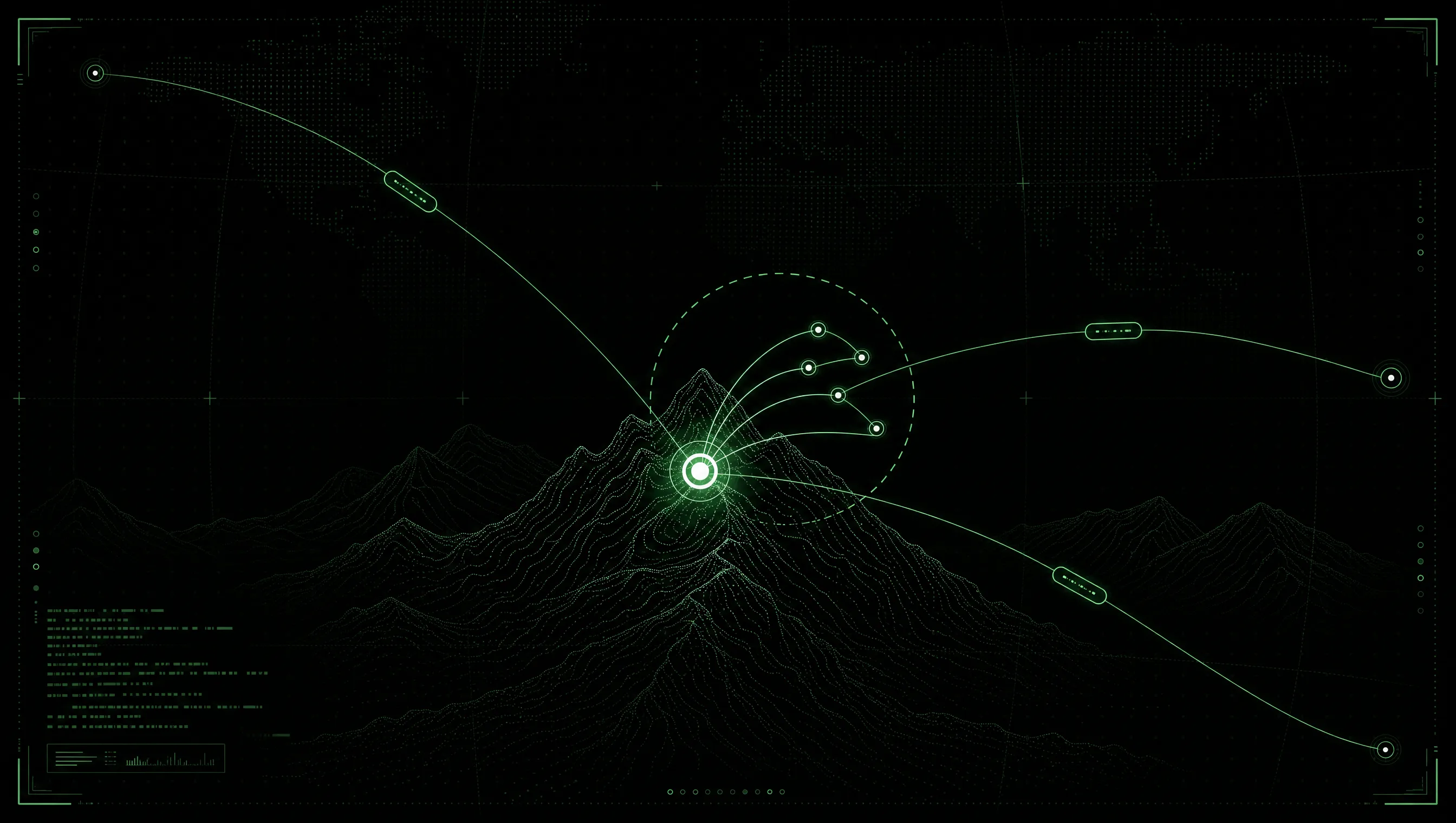
An AI answer knows no national border. Ask in English for a supplier of something very specific and you get an answer in which a business from Bolzano can appear just as readily as one from Hamburg or Turin — provided the machine can place it.
And that is where it gets interesting for a business in a border region. Because placing means two things here: the language of the question and the location of the answer.
Two questions with nothing in common.
“Who does X in South Tyrol?” and “Who does X?” are different tasks for a machine.
In the first, place counts. It is about proximity, travel, reachability — and anyone who has recorded their location and service area cleanly is in the running, even if they are small.
In the second, place does not count at all. It is about suitability: who does this sort of thing, who demonstrably works with it? For specialisations that is the much bigger question — and the one where a small business from a valley stands in the same field as one from a major city.
The mistake I see most often: businesses optimise only for the first question. Everything is phrased regionally, every page carries the place name, and the cross-regional capability is recorded nowhere. So you get found locally and nowhere else — although the skill would travel.
Why the border region has the advantage, if it uses it.
South Tyrol is a rare case: three language markets on one catchment area. For a business that means the same service can be described in three language versions without any of them being translation folklore — they are real markets, with real customers, within earshot.
To machines that is more than a courtesy. A question in Italian and the same question in German are answered separately, from separate bodies of material. Anyone present in only one language is simply not there in the other — not ranked lower, absent. Why three language versions raise citability is set out in Three languages, one citability; that a translate button is not enough, in A translate button does not make one website into three.
What comes on top here is the other direction: three languages are not only three ways into the same local market. They are three ways into three cross-regional markets — the German-speaking one, the Italian one and the international one.
What that means in practice.
Four things that belong together and achieve little apart:
- Place belongs to the business, not in every heading. Address, service area, municipalities covered — as data, once, cleanly. Then the local reference works everywhere without every page heading repeating it.
- The service should be described without the place name. What you can do holds regardless of where you sit. A page that only says “provider in Bolzano” does not answer the second question.
- Each language version needs its own address. A language version without its own address is not a separate source to a machine.
- The specialisation has to be named. The narrower the skill, the wider the reach. For “website” there are thousands of answers; for a very specific field perhaps five — and then place stops mattering.
The sentence this is about.
Capability travels, use stays. What a business can do is not tied to a place — it can be asked for elsewhere. What it does every day very much is: the site, the hotel, the workshop are where they are.
Serving both at once is not a contradiction but a question of filing. Place sits with the business data. Capability sits with the service. A machine handed a location question finds the one; handed a subject question it finds the other. Mix them and you get found for only one of the two — usually the smaller.
The one thing to take away.
Thinking globally does not mean dropping the local. It means writing it in the right place — so the answer to “who can do this?” does not fail simply because everywhere only says where you sit.
Frequently asked questions.
Is AI visibility worth it for a local business in South Tyrol?
Right now more than ever: only 8% of Italian SMEs use AI (Eurostat/Politecnico di Milano) — so local competitors are barely present in AI answers, while 60–65% of the DACH population already actively searches via AI. This window closes a little with every season.
Do you only work in South Tyrol?
Bolzano is the base. Projects run in South Tyrol, Italy and across the DACH region — remotely, well-rehearsed.
What does GEO get me — why should my website be cited by AI?
When more and more people get their answers straight from ChatGPT, Perplexity or Google's AI, whether you get found is no longer decided by your Google ranking alone — but by whether the AI names you as a source. That is exactly what GEO (Generative Engine Optimization) does: it prepares your content so AI systems read it correctly, understand it and cite it in their answers. The benefit is concrete: you get recommended when a potential customer asks the AI for a provider like you — with clear, independently readable statements, structured data and machine-readable formats. If you're not visible here, you simply don't exist for this growing group of searchers.