The NAP error: recommended wrong instead of not at all
Berger+Team · Sep 9, 2026
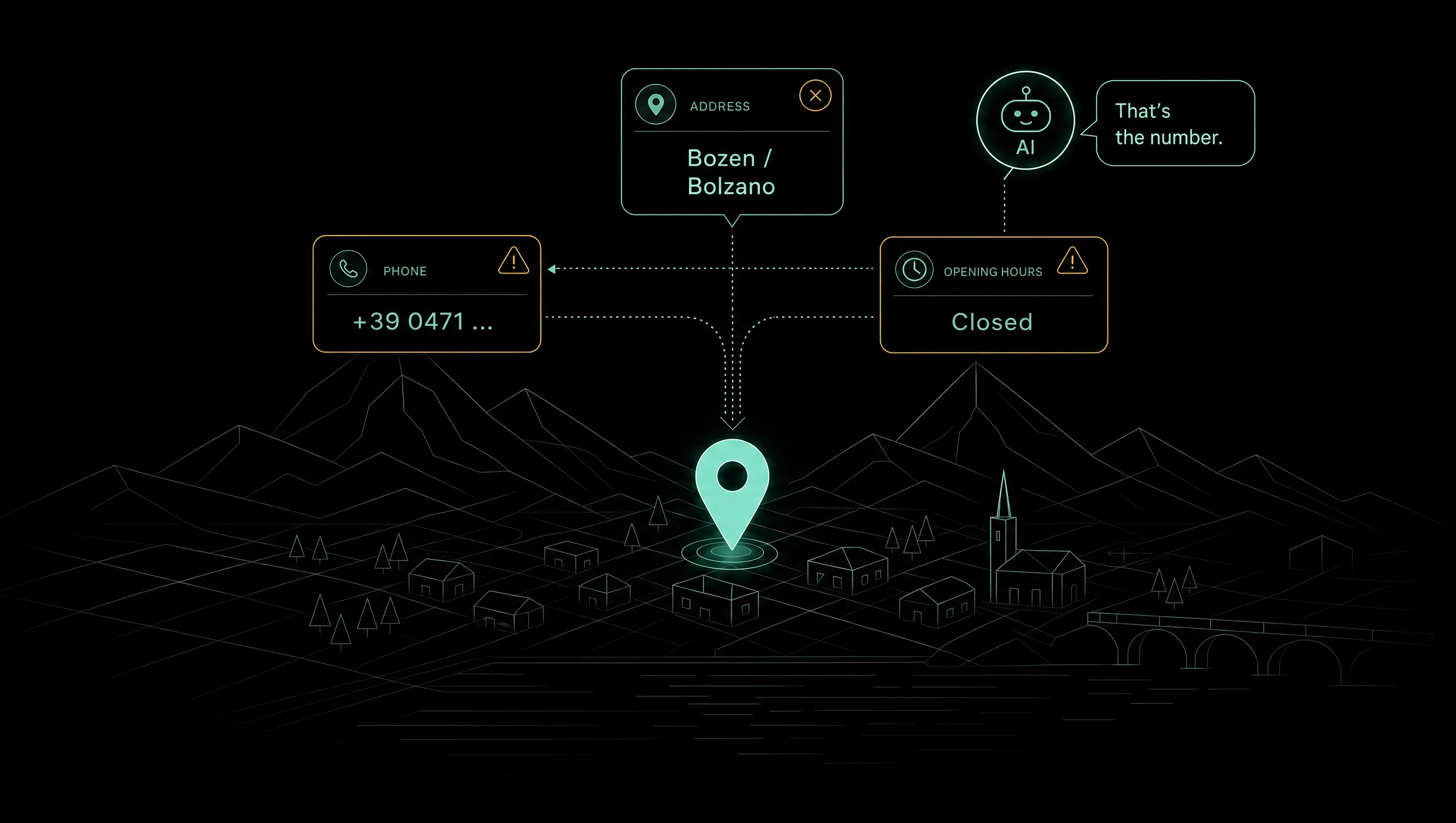
Picture a Thursday evening. A guest is standing at your door — and it's closed. Their AI app had told them you're open until 10 pm. In fact you close at 8, as you always have. Except: an old business directory still says 10. The guest is annoyed. And they're not angry at the directory they've never heard of. They're angry at you.
That's the NAP error. And it's trickier than it sounds.
What NAP means — and why the AI cares
NAP stands for Name, Address, Phone. These are the three details someone uses to find and reach you. Sounds trivial. The problem: these three details sit in many places — your own site, map services, booking portals, old business directories, social profiles. And they're not the same everywhere.
Sometimes it's the old mobile number. Sometimes "St." instead of "Street". Sometimes an opening time that was valid two years ago. To a human these are trifles — they don't even see the contradictions, because they only look at one source. To an AI they aren't trifles. Because an AI looks at every source.
Why the AI turns a small error into a big problem
AI assistants like ChatGPT, Perplexity or the AI answers in Google Search don't invent their facts. They draw them from exactly this map and directory data. What's written there becomes the answer your customer gets. If the source is wrong, the answer is wrong — and the AI says it with full conviction.
On top of that comes an amplifier: many directories copy their data from one another. An outdated entry in one place migrates to five more — and suddenly the wrong number is the "majority opinion" online. That's exactly the one an AI likes to take, because it appears in many places.
Recommended wrong is worse than not recommended at all
Being recommended wrong damages you more than not being recommended at all, because it actively destroys trust instead of merely missing a chance. Whoever doesn't appear in AI answers at all misses a chance — annoying, but invisible. Whoever appears wrongly loses trust. The guest at the closed door, the call to a dead number, the drive to the old address: every time the AI was confident, every time the blame fell on you. And the customer doesn't remember the directory. They remember your name.
The way out: one detail, one truth
The solution is unspectacular but effective: your NAP data belongs in one reliable place that all other channels draw from — instead of in ten places that contradict each other. That's exactly what a foundation acting as a single source of truth delivers: you update the opening time once, and it's right everywhere.
The practical first step costs nothing but half an hour: ask an AI about your business yourself — hours, address, number. Is it all right? If not, you know where your NAP error hides. And you know that right now someone might be standing at your door you never saw coming.
Which further company details belong in machine-readable form is in Structured data for a small business.
Frequently asked questions.
Why does an AI recommend me with the wrong number or opening hours?
Because AI assistants don't invent their facts — they pull them from map and directory data. If your details are inconsistent or outdated there — an old number, a wrong opening hour — the AI picks up exactly that and states it confidently as an answer.
Directories also often copy from one another, so a single error spreads across several platforms. For your business, that means a small inconsistency in one place can end up as a wrong answer in several AI responses.
Why does a media break cost me real money?
Because every media break is unpaid manual work — and manual work costs time and produces errors. A media break occurs when a piece of information has to be transferred from one system to the next by hand: for instance a customer sitting in the booking tool who is then typed into the newsletter list by hand again. In the process typos, outdated copies and contradictory data creep in. The more separate, isolated tools a business uses, the more media breaks — and the more expensive it gets in time and errors. A single source of truth, from which all systems draw the same data, removes the problem at the root.
What does GEO get me — why should my website be cited by AI?
When more and more people get their answers straight from ChatGPT, Perplexity or Google's AI, whether you get found is no longer decided by your Google ranking alone — but by whether the AI names you as a source. That is exactly what GEO (Generative Engine Optimization) does: it prepares your content so AI systems read it correctly, understand it and cite it in their answers. The benefit is concrete: you get recommended when a potential customer asks the AI for a provider like you — with clear, independently readable statements, structured data and machine-readable formats. If you're not visible here, you simply don't exist for this growing group of searchers.
How do I find out whether an AI gives wrong information about my business?
Regularly ask the major AI assistants about your own business — services, opening hours, prices, and how you compare to competitors — and check the answers for accuracy. Without this check, wrong information often only surfaces when customers arrive with false expectations or never get in touch at all.
What do I do about outdated listings on portals and directories I don't have access to?
Getting it corrected is almost always possible — even if you never created the listing yourself: most portals and directories offer a "claim your business" or correction process that hands you back control of your own entry.
The practical path: start with the sources that matter most — the map service, the major industry directories, the review platforms you show up on. Claim your listing on each one and unify the details: name, address and opening hours need to match your own website exactly — it's the leading source everything else should follow.
The effort pays off beyond the correction itself: AI systems cross-check multiple sources before recommending you. The more consistent your details are across every platform, the more reliably and often you get cited. Your own digital foundation is the reference point — the place you align every outside listing to, instead of chasing down each outdated directory one by one.