Every program knows only its piece
Florian Berger · Sep 26, 2026
Topic: AI & automation
Ask yourself something quick: in how many places are your opening hours written down? On your own site, in the booking tool, on Google, in two social profiles, maybe still on a flyer. And now the honest question: are they correct everywhere? Or is at least one of them out of date?
If you hesitate, you know the problem we're talking about. It has a name: island solutions. Every program in your business knows only its own piece. The till knows nothing about the newsletter, the booking tool nothing about the review platform, the spreadsheet nothing about all the others. Five islands, no mainland. And the price for it is on no invoice.
I've been seeing this for over twenty years in businesses of every size — from the tradesperson to the hotel. Not one of these programs was a wrong decision. And yet, in sum, a state arises that nobody has a handle on anymore. Let's talk straight about what it really costs — and why in 2026 it costs more than ever.
The price that's on no invoice
The real price of island solutions is two things: lost time and wrong data. The subscription fees, by comparison, are the smallest problem.
Lost time, because the same information gets typed in over and over. The new customer lands in the booking tool, then again by hand into the newsletter, then onto a list. Every break between two systems — a "media break" in the jargon — is manual work nobody pays for and that comes up every single day.
Wrong data, because no system holds the truth on its own. Whoever buys a separate tool for every task ends up with many tools, but no toolbox.
On top of that, it's precisely small businesses that don't have the time. In a 2026 Bitkom survey of 604 German companies with 20 or more employees, 66 percent name lack of time and 48 percent lack of financial resources as hurdles to digitalization. That's honest, and it matches what I hear in conversations: it's not the will that's missing, it's the air to look after ten systems on top of daily business.
Why small businesses feel it most
A corporation has an IT department to manage the zoo. You have yourself — or a colleague who does it on the side. That's exactly why fragmentation hits small businesses harder than large ones. Every extra island, for you, isn't a ticket in a system, but half an hour of your week.
And regionally the starting point is a particular one. The European digital report shows for Italy: around 70 percent of small and medium businesses reach a basic level of digital intensity — but only 8.2 percent use artificial intelligence (EU Digital Decade, Italy country report 2025). That gap is the real point. It's not digitalization that's missing. It's the connection. The businesses are digital — but in islands.
That's not bad news. It means: the leap forward isn't a fresh start, it's a tidy-up. The substance is there. It's just scattered.
The wall to AI
Until recently this was a pure efficiency topic. Save time, avoid errors — important, but internal. Since your customers started asking an AI assistant instead of Google, it has become a visibility topic.
When someone asks an AI "Who does something like this nearby?" or "Is the business open on Thursday?", it answers with a name. Yours or a competitor's. For it to name yours and get it right, it needs a reliable source: your facts — services, hours, location, languages — in one place, current and unambiguous.
And here the circle closes. Exactly the fragmented data that costs your team time internally is the data an AI fails on externally. If your opening hours sit in five places and three are wrong, the AI guesses. And when it guesses, it often gets it wrong — sounding confident all the while. Island solutions are therefore not just expensive. They make you unreliably citable. Two problems, one cause.
A single source of truth — honestly reckoned
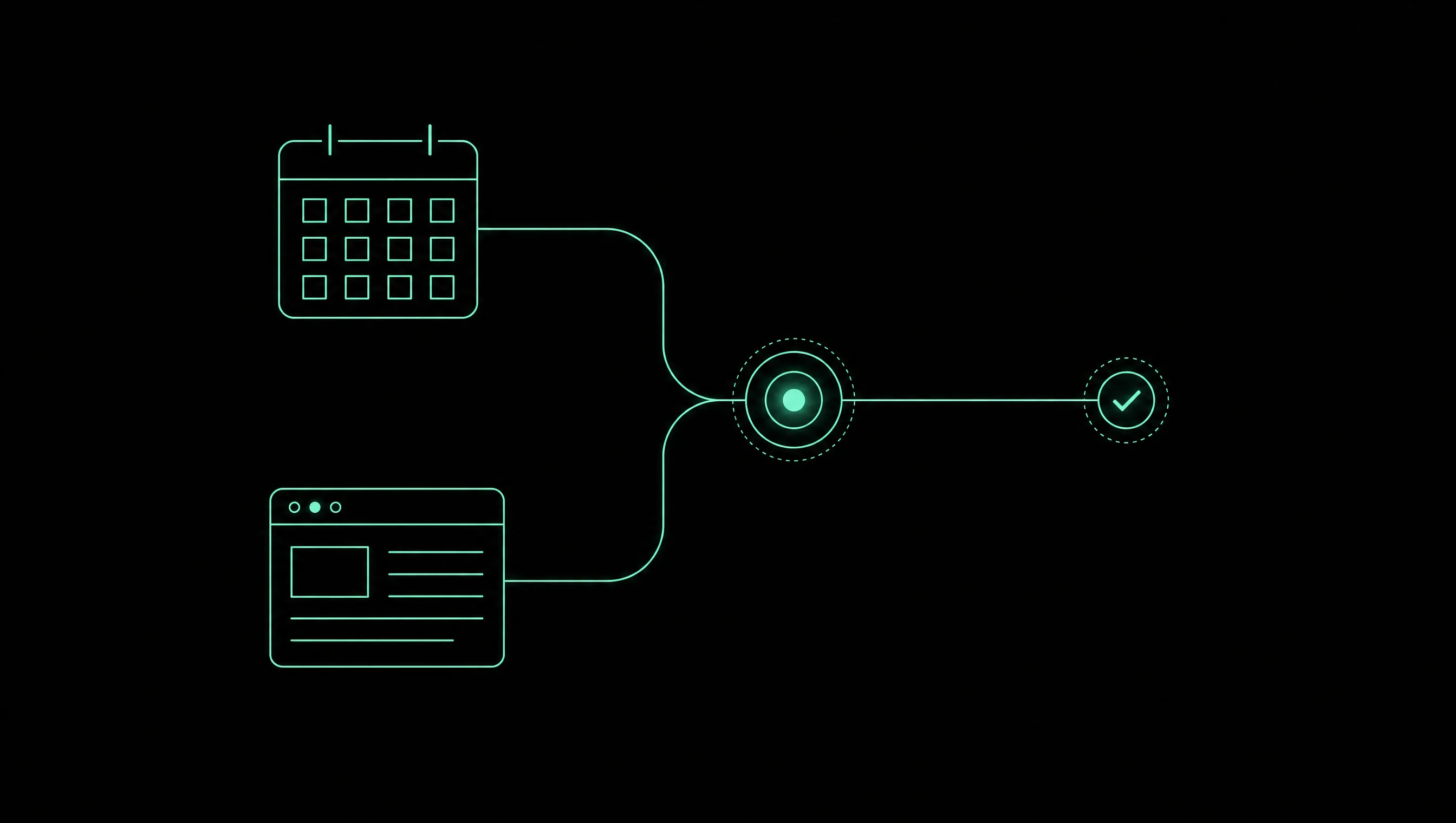
The solution isn't yet another program that connects all the others. That would be another island. The solution is a foundation on which your most important facts and content live in one single place: cleanly structured, machine-readable, and yours. A single source of truth from which everything else draws — your public presence, your multilingual content, and the facts an AI can draw on when it answers about you.
And because I'm honest: that doesn't mean overturning everything tomorrow. Nobody rips out a working till because an article recommends it. The path is staged — you start where the fragmentation hurts most, and tidy up piece by piece. What such a realistic path looks like I've walked through with a concrete example: from the island zoo to a single source of truth. And why the hidden costs are so much higher than the plain subscription prices you'll find in more detail in the piece on the true costs of tool sprawl.
No overhead, no big system switch with account managers and armies of consultants. A foundation that grows with you, and a tidy-up that pays off from the first step — in saved time, in errors that no longer happen, and in your business providing the right facts for the next search generation.
At the end, ask yourself the same as at the start: in how many places are your opening hours written down? The day the answer is "in one" is the day no program knows only its own piece anymore — but the whole business.
If you want to see where your first island costs you the most time, that's a good topic for a short conversation. Get in touch, and we'll look together at where your path to a single source of truth begins.
Frequently asked questions.
Why does a media break cost me real money?
Because every media break is unpaid manual work — and manual work costs time and produces errors. A media break occurs when a piece of information has to be transferred from one system to the next by hand: for instance a customer sitting in the booking tool who is then typed into the newsletter list by hand again. In the process typos, outdated copies and contradictory data creep in. The more separate, isolated tools a business uses, the more media breaks — and the more expensive it gets in time and errors. A single source of truth, from which all systems draw the same data, removes the problem at the root.
What is btlabs Core, exactly?
btlabs Core is the platform we build websites on: fast, trilingual, free of cookie banners — and with your data in your hands.
The difference from a website builder lies underneath. Your content does not exist as finished pages but as structured data. From that the website for people is generated, and the same source answers the questions of search engines and AI assistants. One place to maintain, many channels.
btlabs Core is developed by Berger+Team, a freelancer collective in South Tyrol.
Isn't a drag-and-drop site builder cheaper?
In the short term, yes, no question. But over time you pay a subscription that grows with every new feature, and you stay technically locked into the provider — switching means rebuilding almost everything from scratch. Core, by contrast, is a one-time investment: you pay for the build, not for using your own website.