Fewer Clicks, Better Customers: Why Zero-Click Search Won't Ruin Your Business
Berger+Team · Sep 26, 2026
Topic: Measuring visibility
When your Google traffic collapses, the first reflex is panic. Fewer visitors, fewer inquiries, fewer jobs — so goes the logic. But that logic no longer holds. In the era of AI search, a visitor's value decouples from the sheer number of clicks. Once you understand this, you'll see Zero-Click search not as a threat, but as a better business model.
The numbers are real — and they're harsh
Let's not hide anything: the decline is real and measurable. As early as 2024, according to the clickstream study by SparkToro and Datos, 58.5% of all Google searches in the US ended without a single click to an external website; in the EU it was 59.7%. Of 1,000 US searches, only about 360 still reached the open web.
By early 2026, this had sharpened further: a follow-up study by SparkToro based on Similarweb data puts the click-free rate in the US at 68.01%. As soon as Google displays an AI Overview, the organic click rate drops — according to an analysis by Seer Interactive across 25.1 million impressions — by 61% — from 1.76% to 0.61%.
Rand Fishkin, who ran the study, puts it plainly: „In the first four months of 2026, a whopping 68.01% of Google searches ended without a click." (SparkToro, 9 June 2026). For comparison he cites the figure from ten years ago — back then around 45 per cent of searches ended without a click.
This is not a storm passing through. This is the new weather.
The click is no longer the currency
The click is no longer the currency because what counts is no longer its volume, but the quality of the visitors who still click. And yet: anyone who stares only at click volume misses the real shift. While volume falls, the quality of the remaining visits rises — and markedly so.
Data from Adobe for US retail shows for March 2026 a 42% higher conversion rate for visitors arriving via AI sources, compared with conventional traffic. (Honest framing: this is a young, fluctuating figure — a year earlier AI traffic was still below that. The trend is turning right now.) Microsoft Clarity measures, across all channels, on average a roughly threefold higher conversion from AI-referred traffic; individual sources sit far higher. On top of that: longer dwell time, deeper navigation.
Put differently: you're trading many lukewarm visitors for a few hot ones.
Why this is so
The reason lies in the machine's groundwork. When an AI assistant names and links your business in its answer, it has already done the relevance check: matched the context, classified the offer, assessed the fit. The person who then clicks that cited link doesn't just happen by. They arrive with a concrete intent — informed or ready to buy.
The classic Google click was often a glancing shot. The AI-referred click is a recommendation someone has already followed.
The math for your business
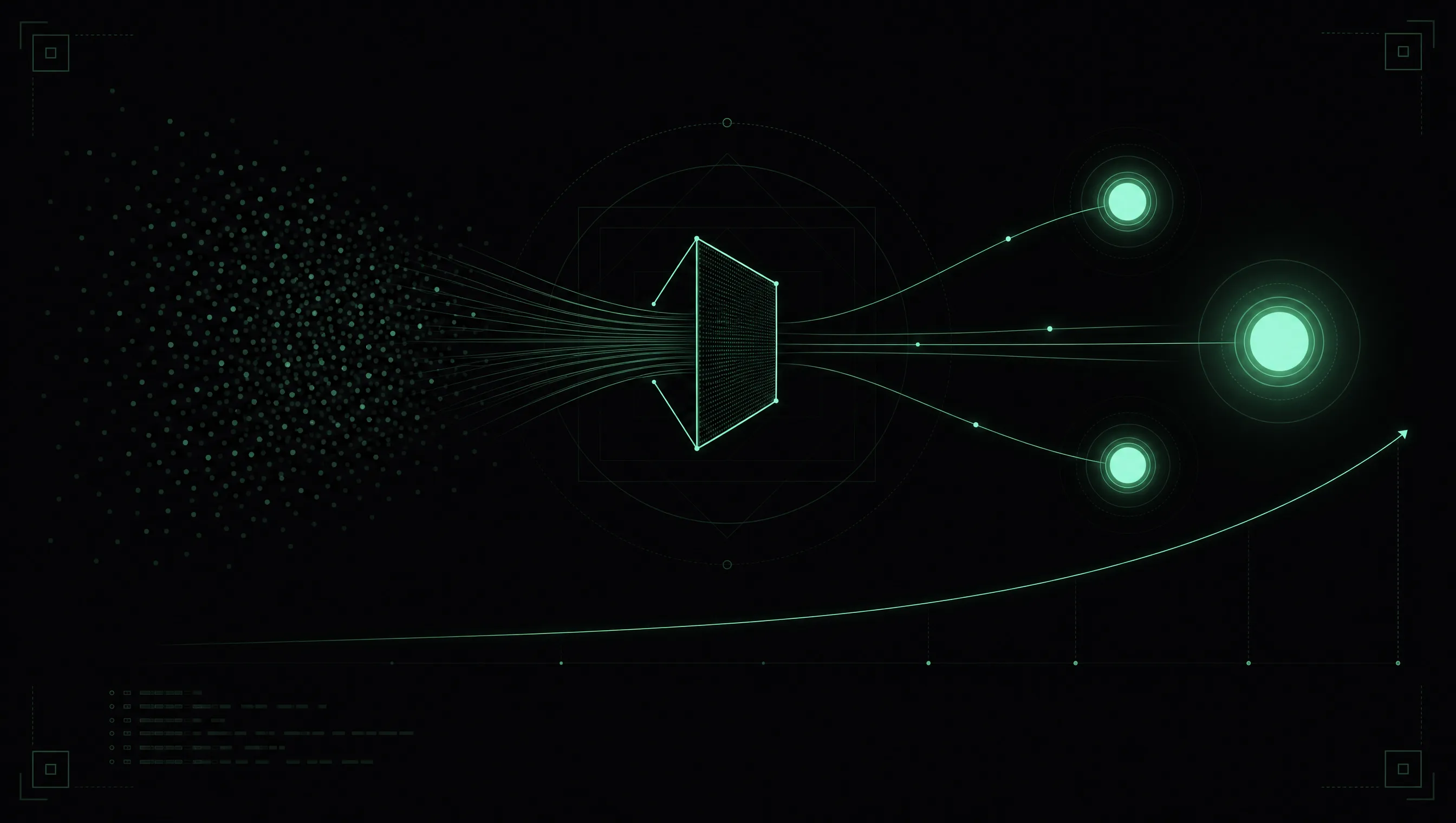
Suppose you lose 70% of your search traffic and the remaining visitors convert three times as well: you end up with roughly 90% of your previous inquiries — from far fewer but better-targeted visits: a higher hit rate, less wasted reach. Set the two effects side by side.
But this math has one condition, and it's harsh: You have to appear in the answer at all. If you don't appear there, there's no pre-qualified visitor who converts better — there's simply nothing. The Zero-Click world rewards those who get cited and passes over the rest entirely. And even those who get cited can't rest easy: how fast that citation fades again is shown in 4.5 weeks: how fast an AI forgets you again.
The condition: appear cleanly
For an AI to include your business correctly in its answer, it has to be able to read your facts unambiguously — structured, contradiction-free, machine-readable. That's not magic, it's craft: clear data about your offer, your locations, your services, from a single maintained source. What this machine channel looks like technically, we've written down step by step elsewhere.
That's exactly what btlabs Core was built for: a foundation that maintains your content once, centrally, and serves it in parallel to people and to AI systems — fast, multilingual, without cookie banners out of the box, on your own EU server.
And because honest beats loud: no technology guarantees you a mention in every AI answer — anyone who promises that isn't serious. What a clean foundation delivers is to improve the chances that you appear, and to lay the groundwork for you to appear correctly. The substance you supply. We make sure it's there, clean and readable.
Sources
- 2024 Zero-Click Search Study — SparkToro / Datos, 2024. sparktoro.com
- In 2026, Less than One Third of Google Searches Still Send a Click — SparkToro / Similarweb, 2026. sparktoro.com
- AI Overviews Impact on Google CTR — Seer Interactive, 2025. seerinteractive.com
- AI-Driven Traffic Surges Across Industries — Adobe Analytics, 2026. business.adobe.com
- AI traffic converts at 3× the rate of other channels — Microsoft Clarity, 2026. clarity.microsoft.com
Note: the Conversion figures for AI traffic are young and fluctuate strongly across sources, industries and months. They show a clear direction, but are not guaranteed average values.
Frequently asked questions.
Does zero-click search change how customers find me?
Yes, and fundamentally so: more and more often the user gets their answer directly on the results page or from the AI assistant — without clicking a single website. For you the value therefore shifts from the sheer click count to the mention: what matters is whether you appear in the answer itself. Whoever gets recommended there wins customers even when no visit happens at all — and whoever optimises only for clicks loses visibility without noticing it immediately in the traffic numbers. In short: you still get found, just in a different place than before.
Are visitors from AI answers worth more than classic Google clicks?
Yes, usually: someone who reaches you through an AI recommendation has already compared options and knows why they're contacting you specifically — the AI has already done the pre-selection. The reasoning: random Google clicks come with a lot of scatter, while with an AI recommendation part of the choice has already been made.
So what counts for you isn't the click count, but how many real inquiries you end up with.
Do AI answers mean I lose website visitors?
Overall, fewer clicks come through — there's no denying it. The AI answers many questions directly, without anyone opening your site at all. This mostly affects simple questions like opening hours or basic prices.
So what matters is no longer raw visitor count, but whether you show up and get recommended inside the AI answer itself. If you show up there, you still win inquiries — just not through a classic website click.
Is AI visibility worth it for a local business in South Tyrol?
Right now more than ever: only 8% of Italian SMEs use AI (Eurostat/Politecnico di Milano) — so many local competitors don't have the topic on their radar yet, while 60–65% of the DACH population already actively searches via AI. This window closes a little with every season.