When AI Cites You Wrong: The Underestimated Reputation Risk
Berger+Team · Sep 25, 2026
Topic: AI discoverability (GEO)
Most businesses worry about being overlooked by AI. The bigger risk is subtler: that AI gets you wrong — and sounds completely convincing while doing it. Wrong opening hours, a service you don't even offer, an outdated price, a mix-up with a competitor. The customer reads it, believes it and never gets in touch. Or they get in touch with the wrong expectations.
How often AI gets it wrong
The error rate is high and well documented: in March 2025, Klaudia Jaźwińska and Aisvarya Chandrasekar of the Tow Center for Digital Journalism at Columbia University published the study "AI Search Has a Citation Problem". They tested eight leading AI search tools — including ChatGPT Search, Perplexity, Gemini, Copilot and Grok — with 1,600 standardized queries.
The result: in over 60% of cases the AI search engines cited the source incorrectly. The spread is dramatic. Perplexity performed best, with an error rate of 37%. Grok-3, the paid version, came in at 94% wrong answers.
Made-up links included
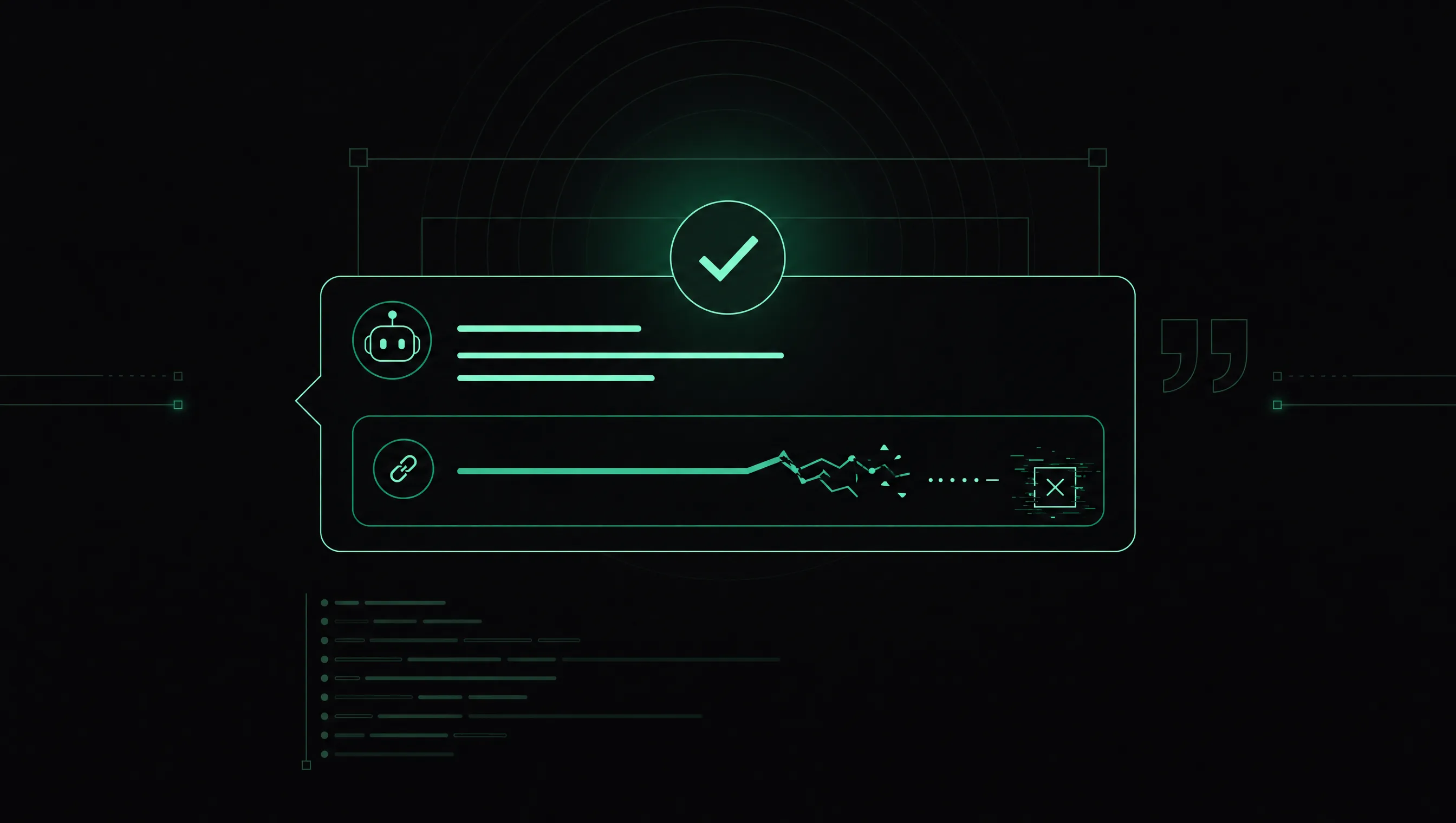
Particularly tricky: the models don't just invent facts, they invent sources too. In the tests, Grok-3 sent users 154 times to a dead 404 error page — more fabricated, broken links than correct citations. A link that looks convincing but leads nowhere isn't a gain for your business, it's a loss of trust.
The real problem: blind confidence
The most dangerous finding of the study isn't the error rate itself, but how the errors are presented. The researchers call it "blind confidence": instead of admitting a knowledge gap, the models phrase things with extreme self-assurance — and are factually wrong.
Out of 134 wrong citations, ChatGPT used a hedging phrase like "it appears" or "possibly" only 15 times. In all other cases, the wrong answer sounded just as assured as a correct one. Only Microsoft's Copilot was an exception, preferring to decline an answer when the facts were thin rather than guess.
For the person in front of the screen, this is fatal: when the machine answers in a fluent, self-assured tone, there's no warning signal. Right and wrong look identical.
Why this hits your business in particular
At their core, AI models are probability machines: they calculate the most plausible next statement. When such a model encounters patchy, contradictory or unstructured information about your business, it fills the gaps — not with truth, but with what's statistically nearest. If your address appears differently on three platforms, if your range of services is nowhere clearly declared, if your details contradict each other: that's exactly when the machine starts to guess.
The consequence is uncomfortable, but unambiguous: the burden of proof is on you. It's not enough to have correct information somewhere. It has to be available so unambiguously, free of contradiction and machine-readable that AI has no room left to guess.
Clarity is the defense
The antidote is called Entity Clarity: your brand, your services, your data must appear across the entire web as one coherent, contradiction-free picture. A single, well-maintained data source, prepared in a structured way (for instance via JSON-LD), delivered consistently — that removes the ambiguity that otherwise trips AI up. How this machine-readable foundation works technically, we describe in detail elsewhere.
This is exactly where btlabs Core comes in: your business data is maintained centrally once and delivered to humans and machines in a clean, structured form — from a Single Source of Truth, without visual marketing and machine-readable facts drifting apart.
Honest stays honest: no technology can force an AI to always cite correctly — the models are too probabilistic for that. But if you present your facts unambiguously and with evidence, you can lower the risk of misrepresentation and increase the chance that "AI knows you" becomes "AI knows you correctly".
Sources
- AI Search Has a Citation Problem — Tow Center for Digital Journalism, Columbia University, March 2025. cjr.org
- AI search engines fail to produce accurate citations in over 60% of tests — Nieman Lab, 2025. niemanlab.org
- GEO: Generative Engine Optimization — Aggarwal et al., ACM SIGKDD 2024. arxiv.org/abs/2311.09735
Note: the study captures a single point in time — error rates for individual models change with new versions. The underlying challenge (uncertain sourcing, high confidence despite errors) holds regardless of the specific figure.
What follows from that for accountability is in When the machine answers for you — who is accountable?
Frequently asked questions.
How do I find out whether an AI gives wrong information about my business?
Regularly ask the major AI assistants about your own business — services, opening hours, prices, and how you compare to competitors — and check the answers for accuracy. Without this check, wrong information often only surfaces when customers arrive with false expectations or never get in touch at all.
Can I correct wrong AI-generated information about my business?
You can't directly correct a single AI answer — but you control the sources it's built from. AI systems rely mainly on your website and public directories such as your Google Business Profile or trade directories.
Concretely: enter the same phone number, address, and opening hours everywhere — maintained in one place that all channels draw from. If that source has current, unambiguous, machine-readable details, it can gradually crowd out outdated or wrong information; realistically it takes weeks to months for AI answers to catch up.
Is being AI-ready worth it for a small business — what changes concretely?
For small businesses in particular it is worth it, because this is where the leverage is greatest: if the big AI systems can read your website without errors and recommend it as a reliable source, you stand a chance of being found and named even alongside larger providers. Being AI-ready concretely means: clearly structured, fully multilingual content, structured data (JSON-LD) and fast, machine-readable HTML — so ChatGPT, Gemini and Perplexity can classify you correctly. It is explicitly not about putting a chatbot on your page, but about making it possible for the AI out there to understand you properly and recommend you.