How an AI Reads Your Website: Chunks of Meaning Instead of Prose
Florian Berger · Sep 9, 2026
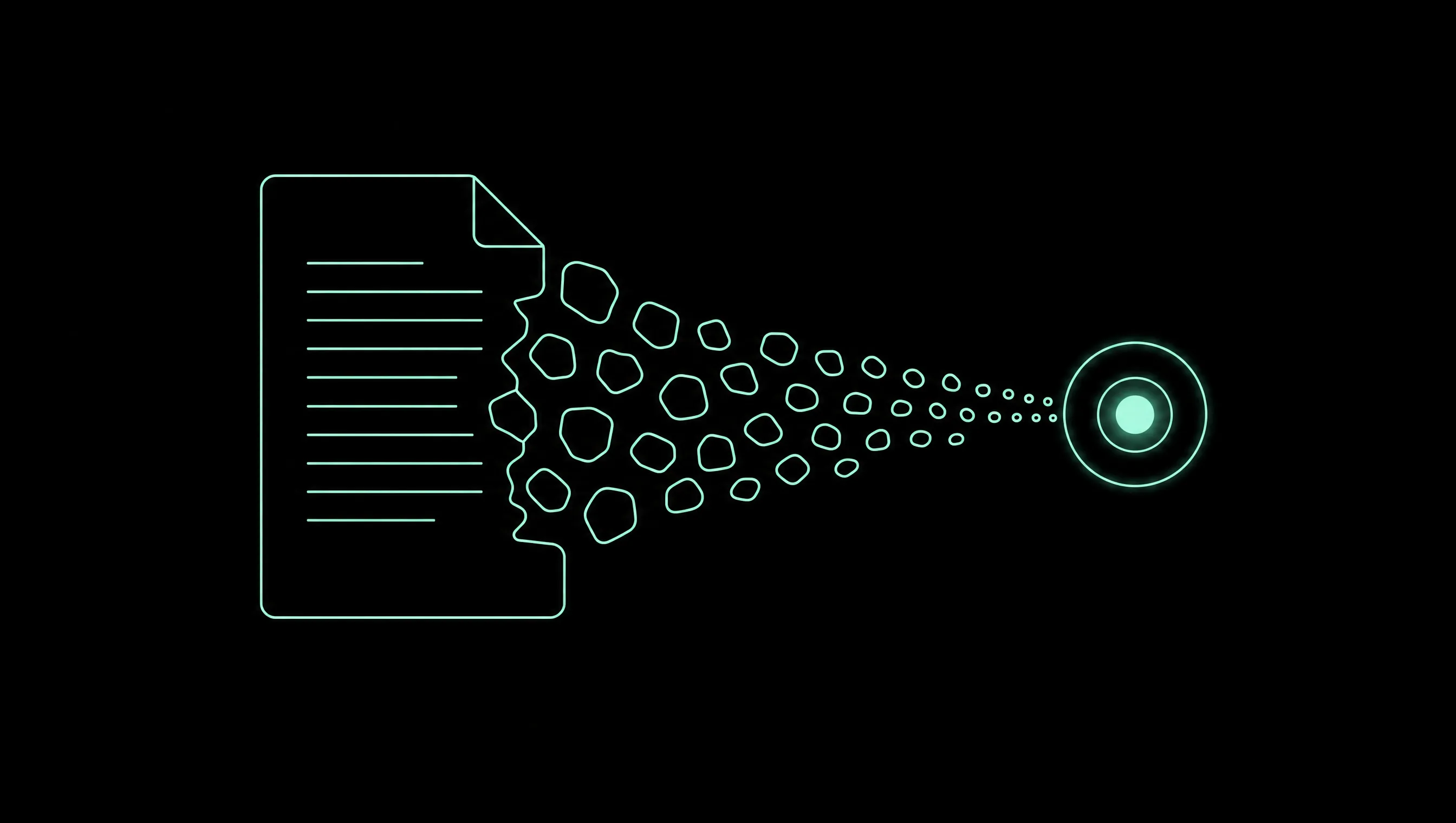
When you ask an AI something about your business, something different happens behind the scenes than most people think. The AI doesn't read your page top to bottom like a human. It breaks your content into small chunks of meaning, picks out the fitting ones and builds its answer from them. If you understand how this process works, you'll build your digital foundation differently — and get cited more often. This article shows you the mechanism.
The AI doesn't read pages, it retrieves passages
An AI answer engine doesn't store your website. At the moment of the question it accesses an index and retrieves individual, self-contained text passages — not whole pages. The technical term is Retrieval-Augmented Generation (RAG): the language model combines its base knowledge with freshly retrieved web passages before it answers.
That's the decisive difference from the classic search engine. Google evaluates a whole page and its ranking position. An AI evaluates individual passages and whether they cleanly answer a concrete sub-question. That's why a page ranking 8th on Google can appear in an AI answer — and a number one might not. A large analysis of Google's AI answers (AI Mode, around 40,000 queries) found that around 88% of cited passages come from pages outside the organic top 10. Ranking and AI visibility are two different games.
The process in four steps
So you can see where your content fails or convinces, here's the typical path from question to answer:
- Breaking down the question. The AI splits a question into several sub-questions. From “Who reliably does X near me?” several internal searches arise — for provider, location, reliability, evidence.
- Retrieving the passages. For each sub-question the AI searches the index for fitting text fragments and filters by reachability, authority and clarity of the thing described. Whatever isn't cleanly retrievable drops out here.
- Assembling. The AI extracts concrete facts from the often raw page source. Content that appears only after scripts load or is hidden behind long introductions often doesn't make it here.
- Citing. The AI formulates the answer and attaches source references — the passages that made it through the first three steps.
Each of these steps is a filter. Your task is not to have “good content” in general, but to not get filtered out at steps 2 and 3.
Why prose loses and structure wins
A long, beautifully written paragraph is pleasant for a human reader — for an AI it's hard to break apart. If the central statement only comes in the fourth sentence and refers back to the second, the passage can't be cleanly extracted. It isn't self-contained.
What gets through steps 2 and 3 has three properties:
- Self-contained statements. Every key sentence is understandable on its own — the concrete number or fact is right in it, not three sentences above. A passage you can quote without context gets quoted.
- Machine-readable structure. Clear, hierarchical headings, short paragraphs and marked-up facts (structured data) give the AI clean edges to break along. It doesn't have to guess what belongs together.
- Immediately visible content. Facts that sit in the original page source and aren't loaded only via script. What the retrieval doesn't see immediately doesn't exist for the AI.
This also explains why the old SEO craft no longer works here: stuffing with search terms does nothing for a passage if it carries no clear, extractable statement. Substance, clearly phrased, beats keyword density.
What this means for your build
If you build your digital foundation so that it meets the RAG process halfway, you gain visibility no ranking trick delivers. Concretely:
- Answer the core question of a heading in the first sentence beneath it — completely and readable on its own.
- Keep the most important facts as self-contained sentences, with the number or fact right in the sentence.
- Make sure these facts are retrievable in a technically clean way, without script detours.
How this technical readability is built in detail — from structured data to machine-readable markup — we go deeper into in the article From SEO to GEO: the technical architecture of an AI-readable website. And why your page must be built for two audiences from the start — the human and the machine —, you'll read in Dual-channel visibility: why your website must now be built for two audiences.
The core stays simple: an AI doesn't read, it grabs chunks. Structure your content into clear, self-contained chunks and you make it easy to be quoted correctly. Pack everything into prose and you leave it to chance. And that's good news especially for smaller businesses: structure costs no ad budget. An honest tradesperson with clear facts gets cited by the AI just as much as the big name with the biggest budget — here substance counts, not market power. And once those chunks are properly connected, another thought experiment becomes plausible: What if your website knew what was on your calendar?
Want to know how well your own website already holds up to this chunking process? Berger+Team reviews your build with you and shows you exactly where to sharpen it — Get in touch.
How literally a machine goes about it is shown in A machine reads literally.
Frequently asked questions.
What does GEO get me — why should my website be cited by AI?
When more and more people get their answers straight from ChatGPT, Perplexity or Google's AI, whether you get found is no longer decided by your Google ranking alone — but by whether the AI names you as a source. That is exactly what GEO (Generative Engine Optimization) does: it prepares your content so AI systems read it correctly, understand it and cite it in their answers. The benefit is concrete: you get recommended when a potential customer asks the AI for a provider like you — with clear, independently readable statements, structured data and machine-readable formats. If you're not visible here, you simply don't exist for this growing group of searchers.
Do I need to rebuild my website for AI visibility?
Not necessarily. Structured data, clean multilingualism and performance can be retrofitted. But if the foundation is an old tower of plugins, a foundation that brings these things built in is often the faster and cheaper way.
Has classic SEO become obsolete with AI search?
No. Google AI overviews mostly cite pages that already rank well classically. SEO remains the ticket in — AI optimisation (GEO) is the extension with citable answers, structure and visible authority.
How does an AI read my website — and what does that mean for my content?
An AI doesn't read your website top to bottom; it breaks it into individual text passages and, at the moment of the question, retrieves only the fitting ones (Retrieval-Augmented Generation, RAG). What matters is therefore not the whole page, but whether individual passages answer a concrete question on their own and machine-readably. Content loaded only via script or buried in long prose often doesn't reach the AI.