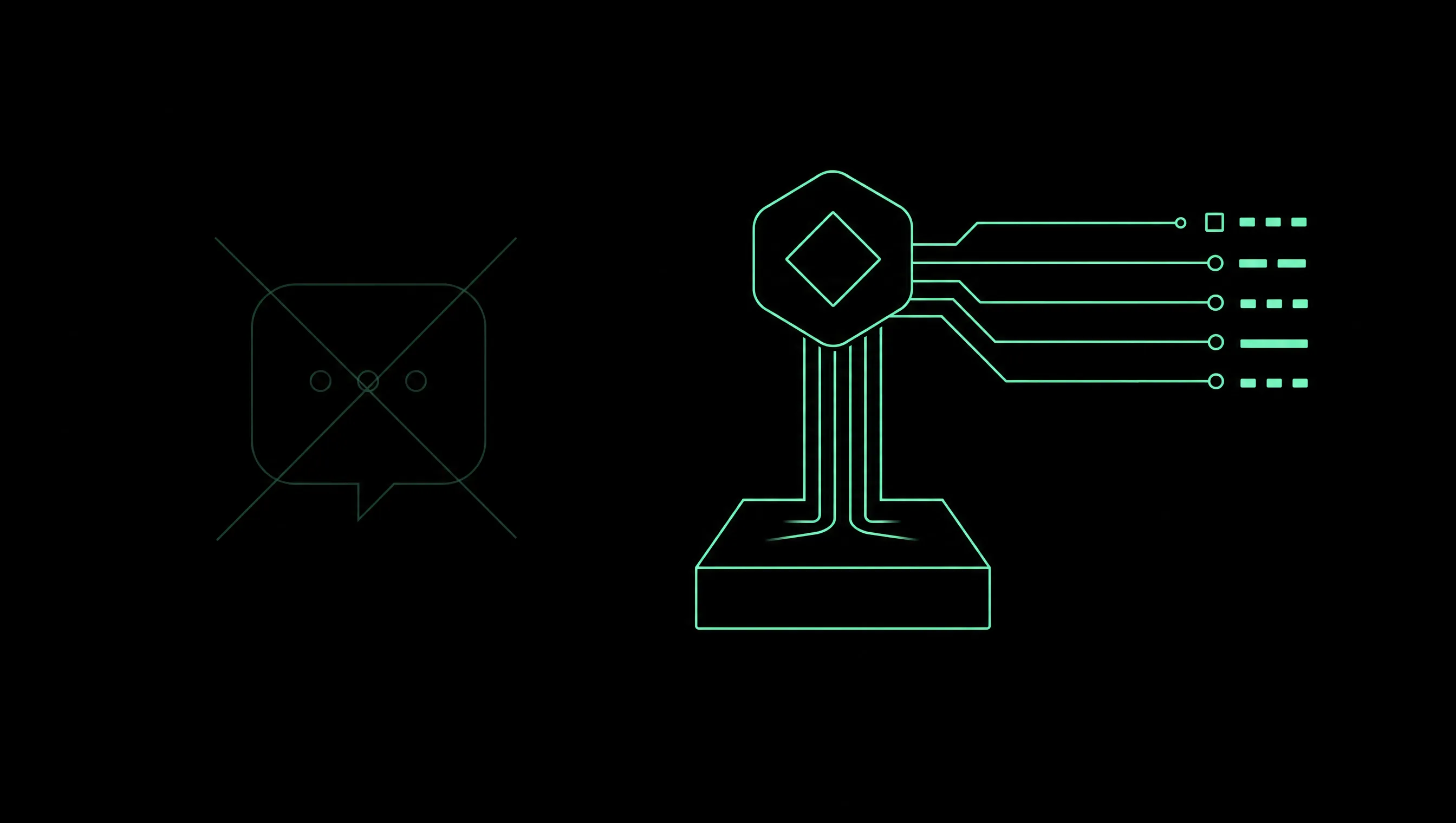
“Agent-Ready” Doesn't Mean “Install a Chatbot”
Berger+Team · Oct 7, 2026
Topic: Machine-readable website
“Agent-ready” is a buzzword right now — and like most buzzwords, it's misunderstood. Many hear it and immediately think: “Ah, so I need a chatbot on the website.” That's exactly what it isn't. This article clears up, in decision-maker language, what agent-ready really means — and why the chatbot answer misses the point.
What a chatbot is — and what an agent is
A chatbot sits on your website and answers questions from visitors who are already with you. An AI agent is something else: it works on behalf of a user, often somewhere entirely different, and gathers information about your business to answer a question or complete a task — without the user ever visiting your page.
The difference is decisive: the chatbot serves people who are already there. The agent serves people who may never come, but still make a decision about you. Being agent-ready means being ready for this second case.
Agent-ready means: being cleanly readable, not able to speak
An agent doesn't want to chat with you. It wants to be able to retrieve your facts reliably, structured and current — services, location, reachability, prices. Agent-ready therefore doesn't mean “install a conversational interface”, but “have a machine-readable foundation” that an agent can access cleanly.
Concretely it's about three things:
- Clear, structured data. Your core information is present so that a machine understands it unambiguously — not hidden in prose or images.
- A reliable source. The agent gets one answer, not three contradictory ones. That requires a single source of truth.
- Currency. What the agent retrieves has to be correct — outdated facts lead to wrong recommendations about you.
None of this is a chatbot. All of it is foundation work.
Why the chatbot answer is expensive and ineffective
If you respond to “agent-ready” with a chatbot, you're investing in the wrong place. The chatbot costs to build and maintain, but serves only those already on the page — and doesn't solve the actual problem: that agents retrieve your facts elsewhere and run into outdated or contradictory data. You treat a symptom and leave the cause open.
What you take away
If someone sells you “agent-ready” while talking about a chatbot, ask: does my data base thereby become cleanly machine-readable and current? If not, it's the wrong tool. Agent-ready isn't an interface you add — it's a foundation you build right.
And where this is heading once an assistant not only reads but actually gets things done is what our thought experiment What If Your Website Knew What's in Your Calendar? explores.
Frequently asked questions.
What does my business gain if AI assistants can talk directly to my website?
Your details are ready exactly where people increasingly ask. Instead of an AI scraping your page and guessing, it reads exactly the content you've provided through an open interface — MCP (Model Context Protocol): services, opening hours, contact details. The aim: fewer incorrect statements about your business and correctly sourced citations — whether an AI uses this route is up to its provider. You stay in control — you decide which content is accessible, and every access is logged.
What is btlabs Core, exactly?
btlabs Core is the platform we build websites on: fast, trilingual, free of cookie banners — and with your data in your hands.
The difference from a website builder lies underneath. Your content does not exist as finished pages but as structured data. From that the website for people is generated, and the same source answers the questions of search engines and AI assistants. One place to maintain, many channels.
btlabs Core is developed by Berger+Team, a freelancer collective in South Tyrol.
Do I need a chatbot on my website?
Usually no. A chatbot only serves visitors already on your site — it doesn't solve the real AI problem: that agents retrieve your facts elsewhere and run into outdated or contradictory data there. “Agent-ready” doesn't mean a chatbot, but a machine-readable foundation with clear, current data from a reliable source. Only once that's in place can a chatbot be a sensible extra — never the first step.