What your business really needs now — before the AI answers for you
Berger+Team · Sep 25, 2026
Topic: AI discoverability (GEO)
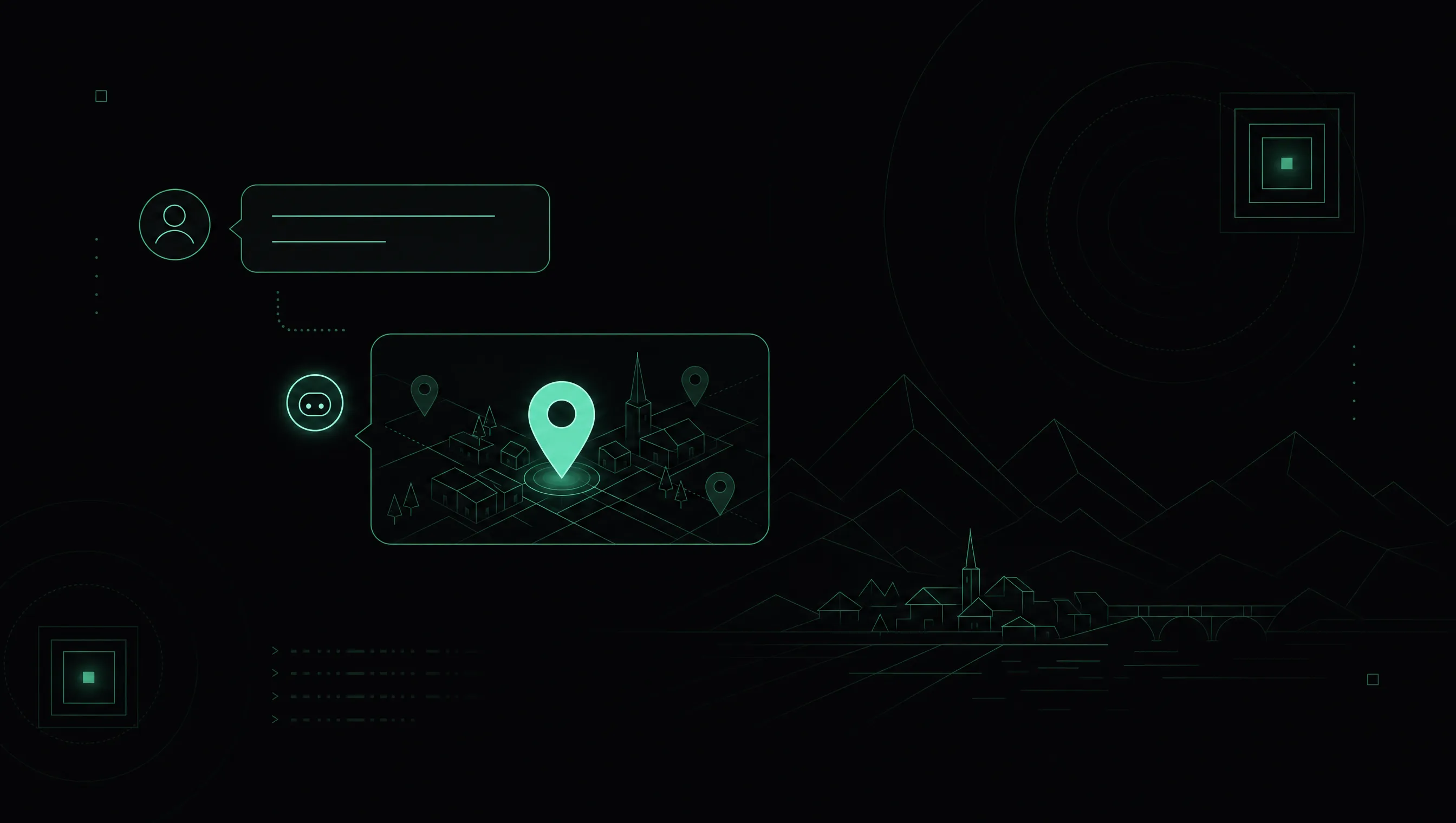
A heating engineer in Bolzano gets an enquiry — the customer had asked ChatGPT, not Google. He wanted to know who services heating systems in the area. ChatGPT named a name. No link. No search results. Just a name. Either yours — or a competitor’s.
This is the quiet shift rolling over most businesses right now. If you don’t appear in that answer — or appear incorrectly — you lose the enquiry before a human ever speaks to you. The good news: you don’t need an expensive specialist department for this. You need a foundation that’s solid.
Here’s what that means, in plain language — covering only the things that genuinely matter to you as a business owner. Want to know where you stand first? Take the 5-minute self-test: go ahead, ask your AI whether it knows your business yet.
Being found. By people and by machines.
A website today has to serve two audiences at once: the people it needs to win over, and the machine that has to make sense of it. Google is one half. AI assistants are the new second half.
What matters isn’t a prettier design — it’s that your core information is clearly recorded: what you offer, where you are, when you’re open, what it costs, how to reach you. If that data is clean and machine-readable, an AI can cite you correctly — with your name, your arguments, your contact details. If it isn’t there, the AI guesses. And guessing does more damage to your reputation than silence.
Control over your own site.
Most businesses don’t pay too much for strategy — they pay too much for the small stuff. Swapping a photo, changing the opening hours, posting a job ad, updating the Italian version. Jobs like these should take minutes and cost nothing — not an email to the agency and three days of waiting.
What you need is a site you can maintain yourself — no code, no risk of wrecking the design. Changing content: yes. Accidentally breaking the design: hardly possible. And if something does go wrong, you can restore an earlier version from the version history.
Turning visitors into real enquiries.
Traffic isn’t a currency. Enquiries are. A site that’s merely pretty, but doesn’t move anyone to take the next step, is an expensive business card.
What really counts: a contact form whose enquiries reliably reach you — with an automatic confirmation to the sender. Genuine customer testimonials with names and ratings. A job advert that doesn’t gather dust as a PDF at the bottom of the page, but has its own address, can appear automatically in Google Jobs and removes itself once the closing date passes. These small things turn “interesting” into “I’ll be in touch.”
A multilingual site that doesn’t descend into chaos.
In South Tyrol, multilingualism isn’t an optional extra — it’s everyday life. German, Italian, English — often it’s the language that decides whether a guest trusts you or clicks away.
The typical problem: the German site is up to date, the Italian one is three versions behind, and nobody notices. You need a system where each language runs cleanly on its own — and a missing translation is flagged up rather than quietly filled in with the German text. One maintenance routine, several markets, no language chaos.
Your data, your content.
In practice that means: visitor statistics without cookies, often with no banner at all — and content that belongs to you, not rented. Cookie banners are a nuisance. And they’re usually a sign that data is flowing to big US corporations in the background. It doesn’t have to be that way: visitor statistics without cookies — and often no banner is needed at all. Less legal risk, more trust.
Then there’s the underrated question: who actually owns your content? With many off-the-shelf systems and rental models, the honest answer is: not entirely you. You want to own your house, not rent it — including the freedom to move out with your content whenever you choose.
Fast and secure — without you having to think about it.
Fast sites keep visitors and are favoured by Google. Slow ones cost trust, especially on mobile. And security — two-factor login, protection against attacks, daily backups — should simply run in the background, without your own IT department. These days that’s standard equipment, not a luxury.
Maintain once. Correct everywhere.
Small businesses don’t need yet another tool. They need fewer of them. Instead of a website here, a PDF price list there, a Google profile and three social channels that all demand their own upkeep and eventually contradict one another, you need one shared foundation: maintain once, correct everywhere. From that foundation a website grows today — and tomorrow a shop or an app, without starting again from scratch.
And because honest beats loud: no system in the world can guarantee you the top spot on Google or a mention in every AI answer. A good foundation simply makes it significantly more likely — and makes your business easy to maintain, fast, visible and independent. The substance — your offering and your clarity — still has to come from you.
What sets us apart
Much of what providers like to list, almost any site can do (“we have backups”, “we’re fast”). The points below are what most off-the-shelf systems and standard websites simply can’t deliver — and they’re exactly what makes the difference in the AI era:
What follows comes from practice, not theory: Berger+Team has been building foundations like this from Bolzano since 2019, with more than 20 years of experience in branding, web and marketing. How the built-in AI automation actually pitches in — from on-brand copy to dialog-based editing — is covered on the linked page.
- Made readable for AI. Your entire business is available in a form ChatGPT & Co. can properly understand — not a chatbot in the corner, but your company’s knowledge made machine-readable, so you can be cited correctly.
- “What we don’t offer” is on record. So an AI can look up what you don’t provide instead of inventing it in your name — leaving less room for false expectations and headaches.
- You decide on AI training. A machine-readable reservation under EU law declares whether AI providers may use your content for training. On most sites, it simply happens without anyone asking.
- One source, many channels. Opening hours, prices, a new service — you enter it once and it’s correct everywhere: website, later a shop, later an app, in every language. No more “the app still showed the old price”.
- Your own server, no subscription trap. Your data doesn’t sit in shared big-tech infrastructure. You invest once in the core system; your data and content stay yours — with a full export available at any time.
- No cookie banner needed in the base setup. The statistics work without cookies. GDPR-friendly by design, not patched on afterwards.
- You can see whether AI is reading you. It’s visible which AI services are accessing your site — and what they’re asking about (price, appointments, contact). An early-warning system that virtually no ordinary website offers.
- Your site improves with you. An optional check, once switched on, regularly flags gaps, contradictions and out-of-date statements. You decide on each finding — so the site grows stronger over time, not weaker.
- Your brand voice is anchored. Tone of voice, preferred and forbidden terms are all documented; every AI task receives them as instructions. Consistent across every channel and language.
- Genuinely separate multilingual setup. Several languages, each with its own address and its own upkeep — and a missing translation is flagged rather than silently substituted.
Frequently asked questions.
Is being AI-ready worth it for a small business — what changes concretely?
For small businesses in particular it is worth it, because this is where the leverage is greatest: if the big AI systems can read your website without errors and recommend it as a reliable source, you stand a chance of being found and named even alongside larger providers. Being AI-ready concretely means: clearly structured, fully multilingual content, structured data (JSON-LD) and fast, machine-readable HTML — so ChatGPT, Gemini and Perplexity can classify you correctly. It is explicitly not about putting a chatbot on your page, but about making it possible for the AI out there to understand you properly and recommend you.
Is AI visibility worth it for a local business in South Tyrol?
Right now more than ever: only 8% of Italian SMEs use AI (Eurostat/Politecnico di Milano) — so many local competitors don't have the topic on their radar yet, while 60–65% of the DACH population already actively searches via AI. This window closes a little with every season.
Do I need to rebuild my website for AI visibility?
Not necessarily. Structured data, clean multilingualism and performance can be retrofitted. But if the foundation is an old tower of plugins, a foundation that brings these things built in is often the faster and cheaper way.
What is the free AI-readiness check?
We check in advance what AI models like ChatGPT currently know about your business — and where your blind spots are. Free and with no obligation: just tick the box in the contact form, and we'll discuss the result in the first conversation.