What is a vector database? Why AI search engines need one to find you
Berger+Team · Sep 25, 2026
Topic: Machine-readable website
A vector database is a store that does not hold texts as words but as long sequences of numbers representing their meaning — so-called embeddings. AI search engines need them because it lets them find the passage that fits in substance, even when not a single one of the searched words appears in it.
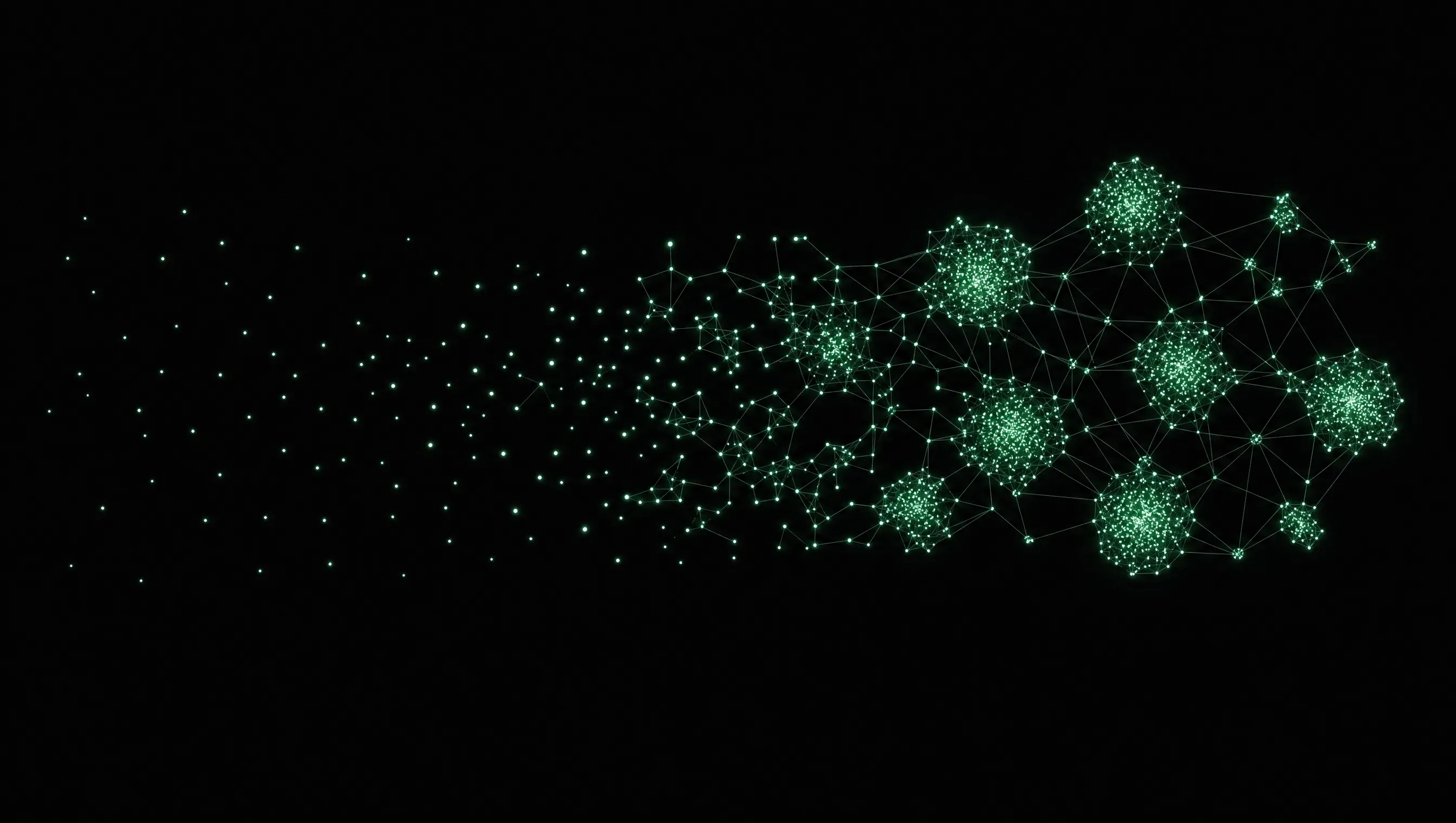
Picture a library sorted not alphabetically but by meaning. “Insulating the façade” sits right next to “thermal protection on the exterior wall” — even though the two shelf labels share not a single word. That is exactly how a vector database arranges texts: whatever belongs together in substance ends up close together.
Why keyword-only search is not enough for this
Keyword-only search is not enough because people name the same thing in twenty different ways. One person searches for a “roofer nearby”, another asks “who fixes my leaking roof?”. A classic word match only finds what agrees literally. Meaning-based search measures the distance between two number patterns instead — and recognises that both questions come down to the same thing.
That is why the old arithmetic of “work in the right keyword as often as possible” no longer works here. A text stuffed with buzzwords has no clear profile for a meaning-based search — it points in many directions at once and in the end fits nothing properly.
What that means for your content in practice
For your content it means this: a clearly written, topically focused paragraph gets found more readily than one trying to squeeze in as many search terms as possible. Three things help more than any keyword list.
- One thought per paragraph. An AI pulls out individual passages, not whole pages. A paragraph that answers one specific question completely is usable — one that grazes three topics is not.
- Call things by their name. “We have been reliably at work for many years” carries barely any meaning. “We have been restoring roofs in the Vinschgau since 1994” carries a great deal of it.
- Facts instead of hints. Place, service, period, responsibility — the more concrete the sentence, the more unambiguous its position in meaning space.
And no — you do not need a vector database yourself
You do not need one: the vector database sits with the operators of the AI systems, not on your website. For your business there is nothing to install, nothing to license and nothing to set up — it is technology on the other side. Anyone trying to sell you a vector database as a product for your website is selling you something that simply does not belong there.
What you can influence is the quality of what arrives there: clear, current, unambiguously phrased facts. That takes the least effort when those facts are maintained in one single place and update everywhere from there — instead of being copied by hand across five spots, one of which eventually falls out of date.
You will find a detailed overview of AI visibility in South Tyrol and the DACH region in the Guide to AI Visibility. And if you want to know how unambiguously your own content is already written today, talk to us.
Frequently asked questions.
How does an AI read my website — and what does that mean for my content?
An AI doesn't read your website top to bottom; it breaks it into individual text passages and, at the moment of the question, retrieves only the fitting ones (Retrieval-Augmented Generation, RAG). What matters is therefore not the whole page, but whether individual passages answer a concrete question on their own and machine-readably. Content loaded only via script or buried in long prose often doesn't reach the AI.
Why doesn't good content for humans automatically translate into AI visibility?
Good content for humans is allowed to be entertaining, evocative and written in marketing language — “Your trusted partner for generations…” reads well to a human. An AI, however, can do little with phrases like that, because they contain no verifiable information.
What AI systems favour is information density: clear, self-contained statements with concrete facts, figures and relationships that make sense even without the rest of the page. The trick is combining both — marketing tone for humans, but with a factual core an AI can cite without having to interpret it.
What does GEO get me — why should my website be cited by AI?
When more and more people get their answers straight from ChatGPT, Perplexity or Google's AI, whether you get found is no longer decided by your Google ranking alone — but by whether the AI names you as a source. That is where GEO (Generative Engine Optimization) comes in: it prepares your content so AI systems can read it correctly, understand it and cite it in their answers. The benefit is concrete: you get a chance of being recommended when a potential customer asks the AI for a provider like you — with clear, independently readable statements, structured data and machine-readable formats. If you're not visible here, you simply don't exist for this growing group of searchers.